From Brand Risk to Advantage: Rethinking Ads in News


%20(1).jpg)
The Missed Opportunity in News Advertising
Every day, advertisers forfeit millions of opportunities to reach engaged, high-intent audiences because those impressions appear in news content. The concern is understandable: one ad placed beside a tragedy or violent incident can pull a brand into the story for all the wrong reasons.
Lacking reliable tools, the industry has responded by overcorrecting. Entire news categories are blocked to eliminate risk, even when the content itself is routine reporting or policy analysis. A segment on new emissions standards—ideal for an electric-vehicle brand or coverage of interest-rate decisions that is highly relevant for a bank often gets excluded along with everything else.
This safety-first approach carries a hidden cost. News is among the most consumed and trusted content online. Audiences arrive with clear intent, already focused on topics like climate policy, healthcare, or the economy, making them especially receptive to relevant messaging. The opportunity is both substantial and uniquely valuable.
The real challenge is separating truly risky moments from premium, brand-safe inventory—and doing so accurately, at scale, and in real time.
Ad Safety Is Not Sentiment
It is easy to conflate ad safety with sentiment, but this misunderstanding can lead to significant wasted inventory. While sentiment focuses on the emotional polarity and the subjective feelings of a speaker, ad safety is strictly about the objective topic and context of the content. To maximize reach, high-performance systems must distinguish between what is being discussed and how it is described, ensuring that tone does not override context.
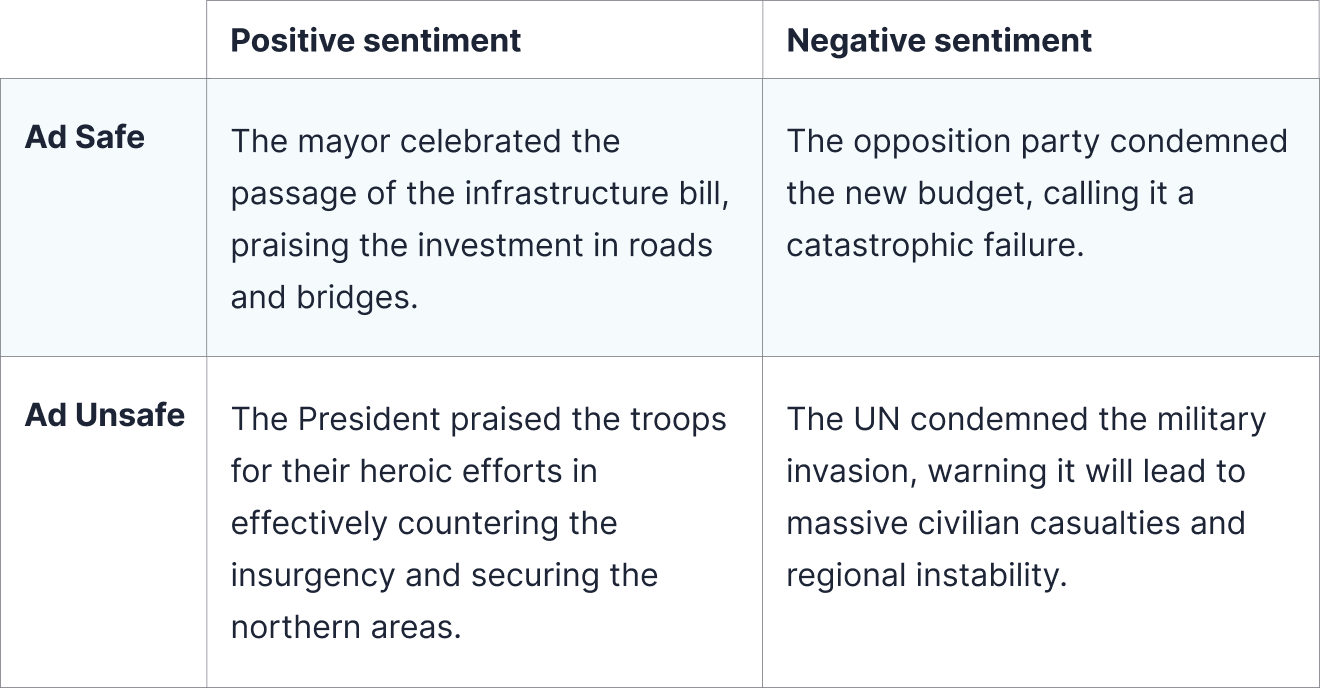
This distinction is critical because research shows that, for typical news channels, 17%–30% of content is ad-safe despite having negative sentiment. As illustrated in the safety-sentiment matrix below, a "catastrophic" budget critique is ad-safe routine politics, whereas a "heroic" report on a military insurgency remains ad-unsafe due to its conflict-related context. By decoupling tone from topic, brands can safely reclaim high-quality inventory that was previously and incorrectly blocked.
How We Built the Model
Standard tools often fail the "real-world" test of live news. We built a custom pipeline optimized for policy alignment and low-latency execution.
The Limits of Off-the-Shelf Models
While general-purpose LLMs and standard pre-trained classifiers are impressive at reasoning, they are often unsuited for the high-stakes, real-time demands of news ad safety. Relying on "off-the-shelf" solutions typically introduces several critical points of failure:
- Inability to parse blended content: News often mixes sensitive material such as violence, disasters, political unrest with adjacent but acceptable coverage such as regulatory updates or community responses. Distinguishing one from the other depends on fine-grained semantic cues that LLMs do not handle consistently.
- Failure to Adapt to Shifting Distributions: The balance of news topics swings rapidly as events unfold. During major global crises, sensitive stories can dominate coverage; at other times, they are rare. Static, general models are not calibrated to stay accurate across these shifts, often leading to skewed safety ratings during breaking news cycles.
- Lack of Nuance in Editorial Variation: Different outlets cover similar stories with varying tones and emphases. Generic models often lack the sophistication to generalize across these styles, inheriting biases that cause them to flag legitimate content as unsafe simply because of a serious tone.
- Prohibitive Latency and Cost: In a programmatic environment, decisions must be made extremely quickly. Prompting large, general-purpose models or routing through generic APIs introduces significant computational overhead and adds avoidable latency, which is a dealbreaker for real-time environments like live news.
Satisfying these requirements demands purpose-built training, robust dataset design, and systematic evaluation, none of which can be achieved through prompting LLMs alone.
Our Specialized Approach
- De-biasing via Synthetic Data: Standard models often develop "keyword phobias." For example, because the word "rocket" frequently appears in news about missile strikes or conflict, a model might learn to block any segment containing that word. We break this bias by generating synthetic "safe" training data. This forces the model to ignore the keyword and instead look for the surrounding context to determine safety.
- High-Performance Architecture: We fine-tuned a transformer model that provides deep semantic understanding in a compact footprint, allowing for the real time inference required for live broadcast.
- Optimization: We use early stopping to ensure that the model does not overfit to our current news distribution. We also incorporate focal loss, which reduces the influence of easy, obvious examples and allocates more learning capacity to the ambiguous or borderline segments that are most critical for accurate ad-safety decisions.
- Real-Time Context Engine: Short snippets may look unsafe in isolation. A clip mentioning an explosion might be about war (ad-unsafe) or it could be about a lab experiment (ad-safe). Our system maintains topic history and uses a custom built topic change detector to anchor snippets in the broader narrative while preventing context bleed when the news shifts stories.
Beyond Safety: Rich Context for Targeting
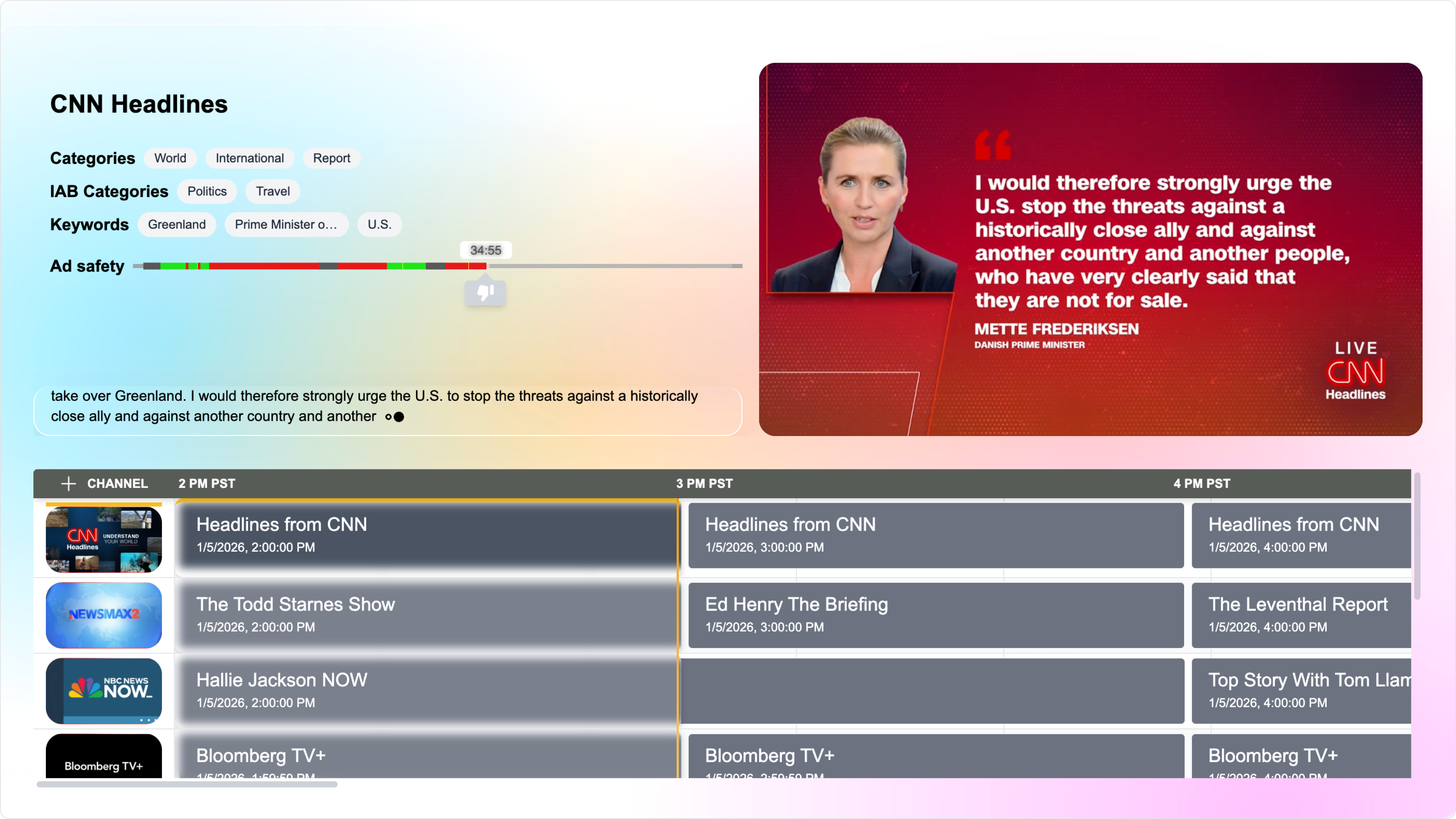
Advertisers don’t just need safety; they need alignment. In addition to ad safety, we enrich each segment with structured metadata that supports more precise and contextually aligned targeting.
Keywords
We extract meaningful phrases such as named entities, product names, and standalone concepts to give a clear view of what the segment is about.
IAB Categories
Each segment is mapped to applicable standard IAB Tier 1 categories such as Business and Finance, Politics, Technology, Sports, and others. This helps advertisers understand and target specific domains.
The charts below illutrates the distinct thematic footprints across major outlets.
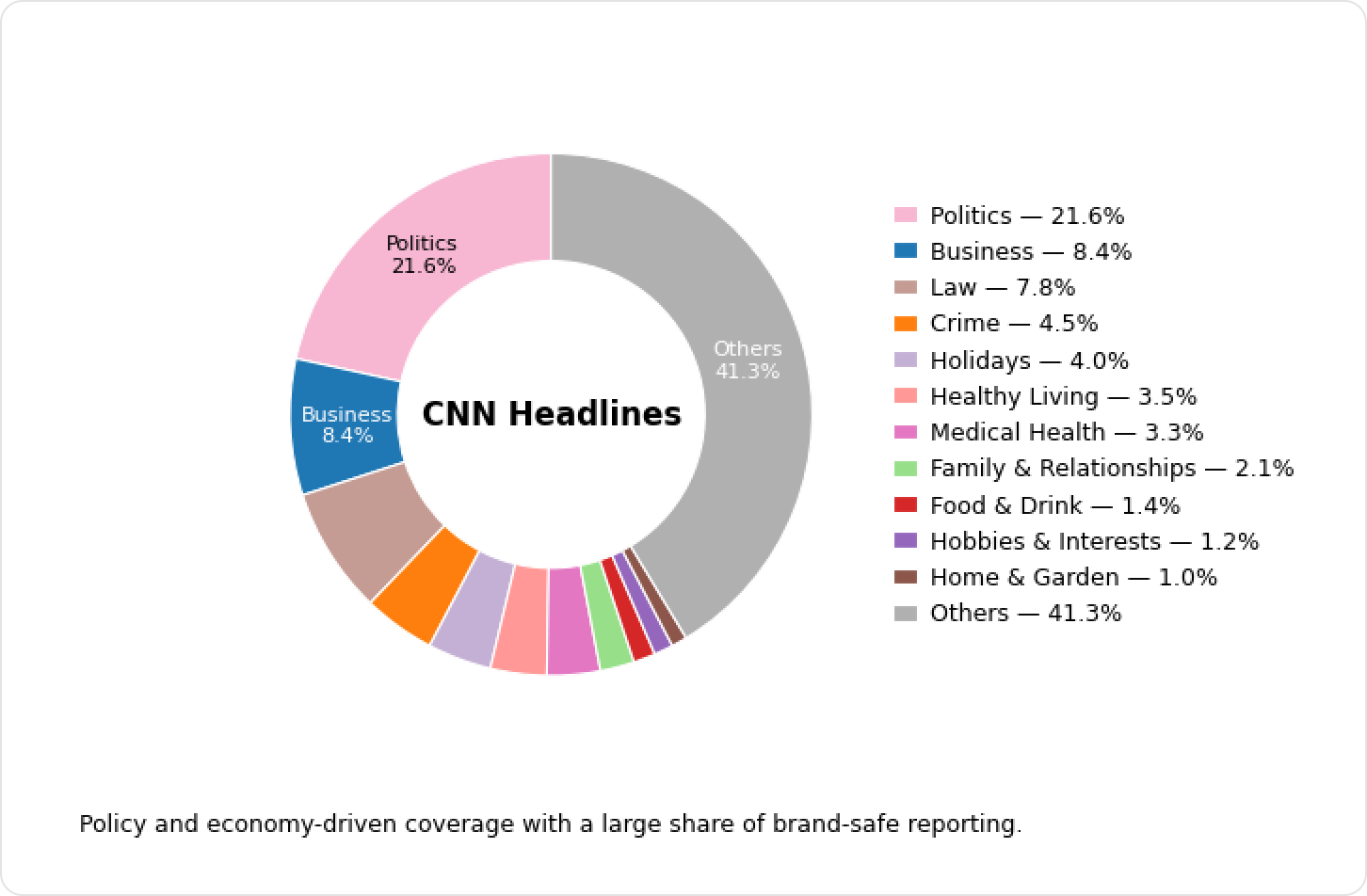
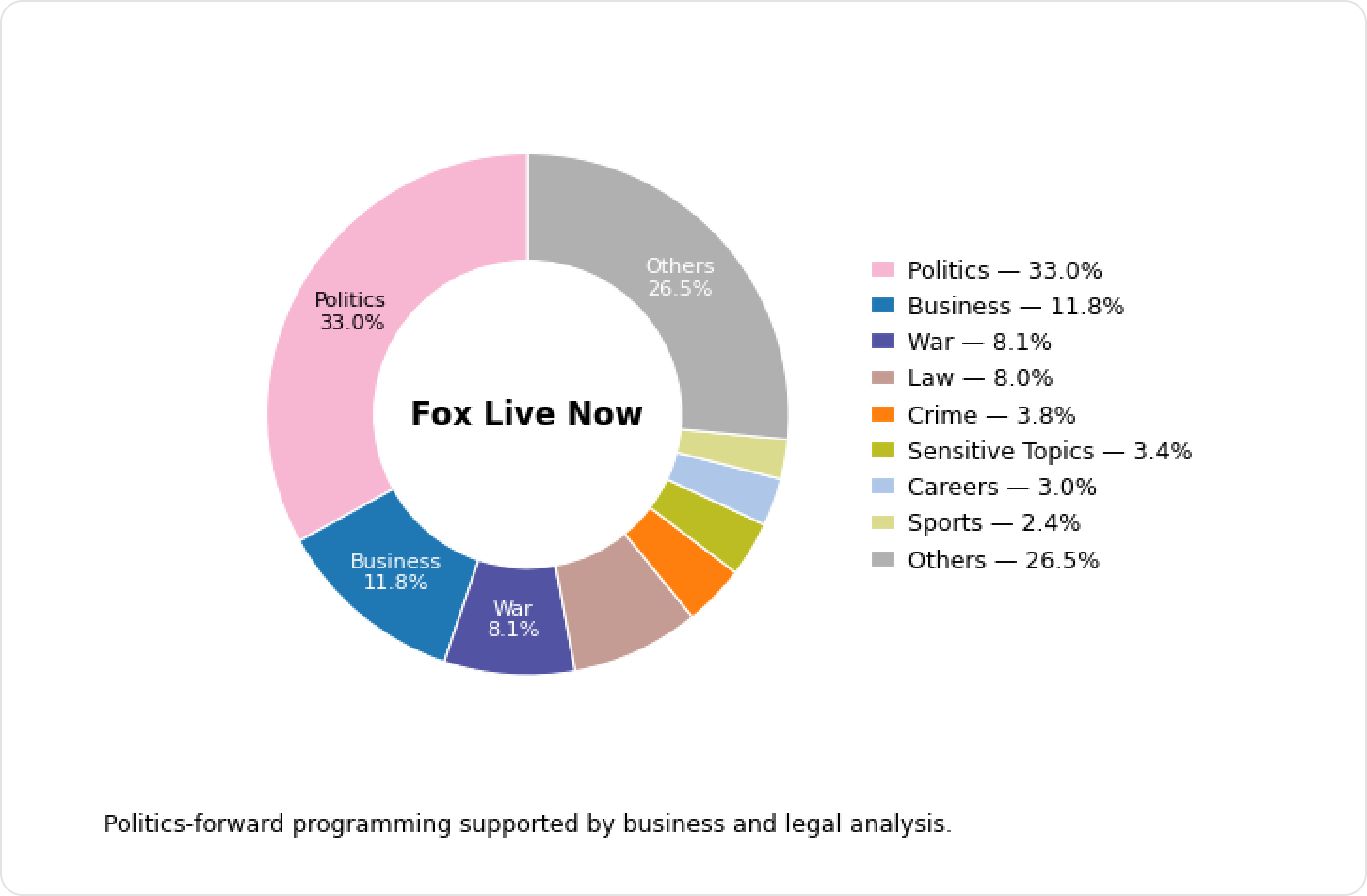

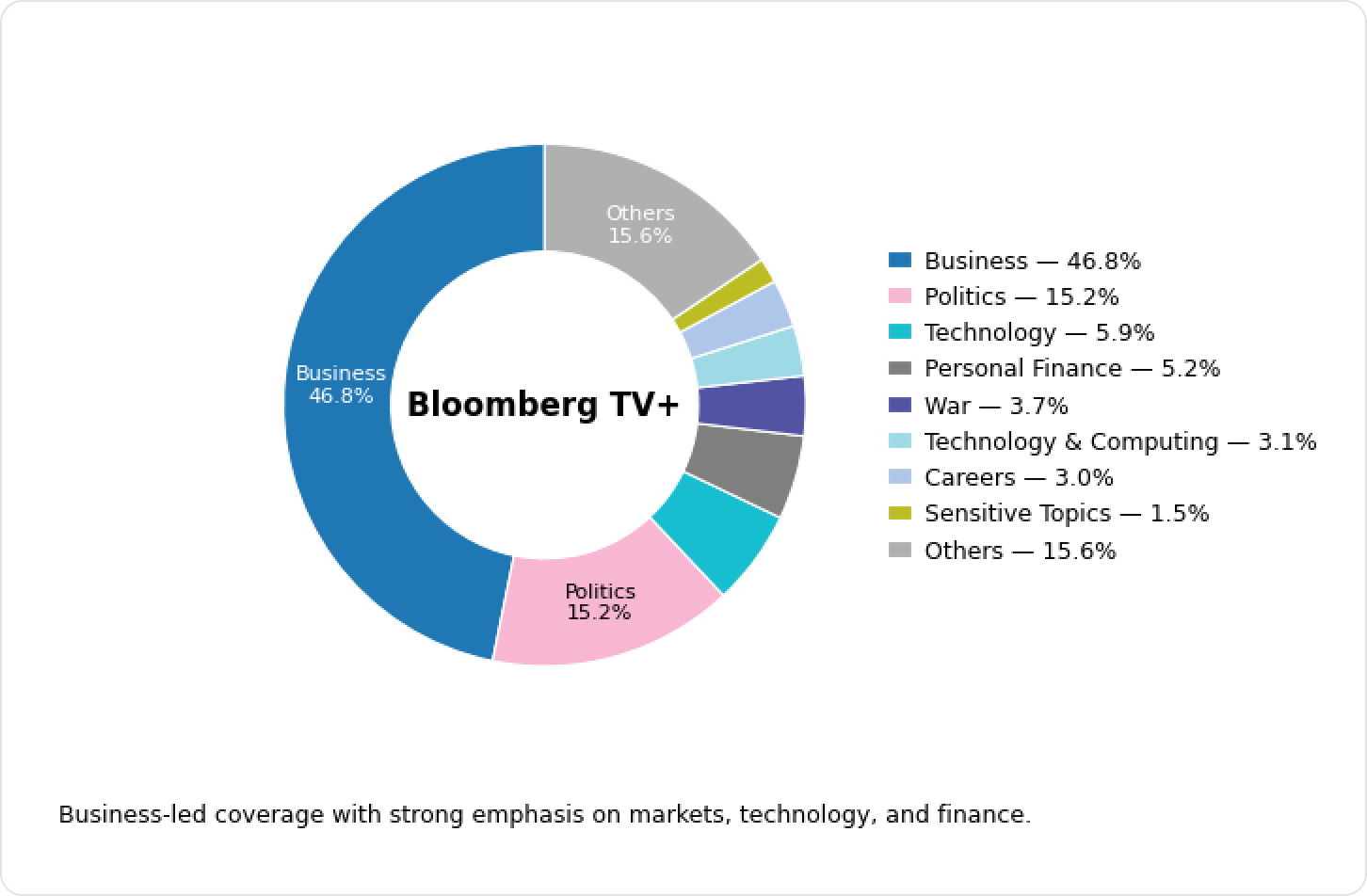
By layering Ad Safety on top of Categorization, we turn raw news into structured, premium inventory that matches a brand’s specific goals rather than a generic "news" bucket.
From Blunt Blocking to Precision Targeting
News does not have to be a blind spot. By replacing blunt keyword blocking with real-time, segment-level analysis, brands can protect their identity without sacrificing reach. Our system identifies truly unsafe moments, understands the geographic and thematic context, and surfaces the stories where your message is welcome.
Our system results in less waste, more reach into high-intent audiences, and better alignment between your creative and the conversations people care about most.